
Short and quick answer by GrammarGramps: Grammar is the system of rules that governs how words combine to form sentences in a language.
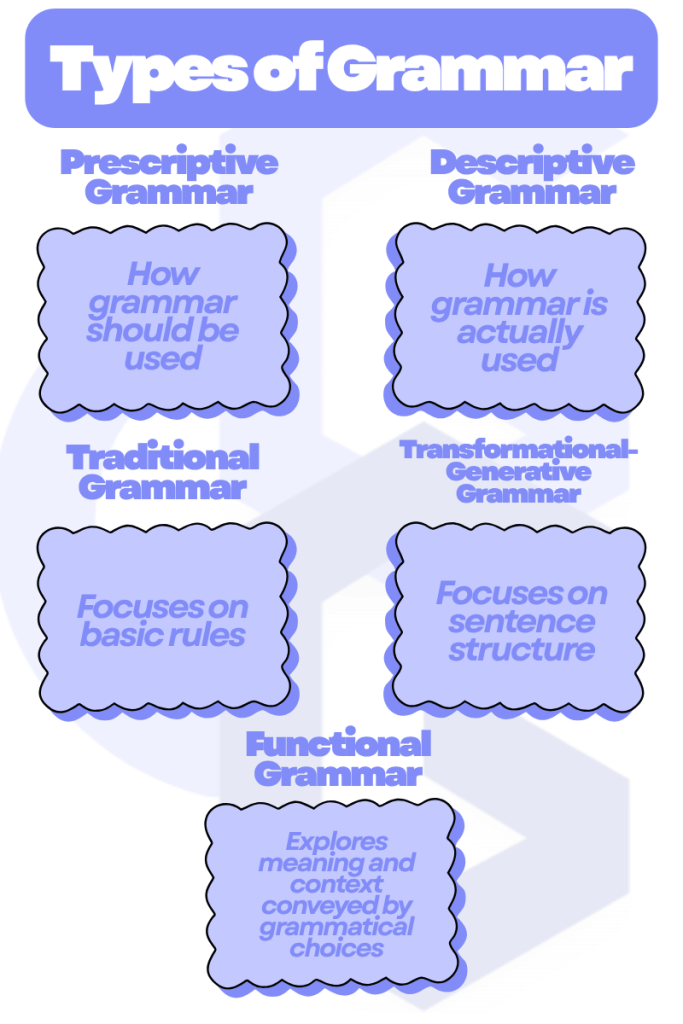
There are five main types of grammar, including prescriptive grammar, descriptive grammar, traditional grammar, transformational-generative grammar, and functional grammar. Each type explains language structure, usage, and meaning from a different perspective.
Common rules of English grammar include subject-verb agreement, tense consistency, correct use of articles, and correct word order.
Read more about all of this in detail in the guide below.
Definition and Special Introduction to Grammar by GrammarGramps
The definition of grammar is as follows:
The word “grammar” refers to the collective set of rules that govern the verbal and written usage of a language.
That’s about it.
Short and sweet.
It makes me sound like the smart intellectuals you would read in your school textbooks who’d reduce the entire chapter’s length of explanations to a short one-liner…and just get away with it.
You know those dudes from the 17th century who go “Botany is plants, studied” with a dash and an italicized signature.
Technically, the sentence above is all that you need to define grammar. But that alone won’t get you very far. It’s important to know things like the the types, the common rules, the history of grammar, etc.
In this guide on what is grammar, we’re going to cover all of those.
When reading the guide, you might run across some grammar terms that you may not know. Don’t worry about those. You can head over to the glossary of English grammar here on GrammarGramps and simply find the definition.
Now, let’s get started.
Types of Grammar
There are five grammar types in English. Basically, grammar can be studied from multiple perspectives, each focusing on a different aspect of language use. Those perspectives are what form the various “types.”
1. Prescriptive Grammar
Prescriptive grammar defines how language should be used and establishes rules for correctness in formal contexts.
2. Descriptive Grammar
Descriptive grammar records how speakers actually use the language, without evaluating usage as right or wrong.
3. Traditional Grammar
Traditional grammar focuses on parts of speech, sentence structure, and basic rules. This is the model most commonly taught in schools.
4. Transformational-Generative Grammar
Developed by Noam Chomsky, this approach examines the mental structures that allow speakers to generate and understand sentences.
5. Functional Grammar
Functional grammar analyzes how grammatical choices convey meaning, intention, and context in real communication.
Table Illustrating the Different Types of Grammar with Examples
Here is a table that I have made that illustrates the various types of grammar with examples.
| Type of Grammar | Focus | Example |
|---|---|---|
| Prescriptive Grammar | Rules for correct and formal usage | For example, prescriptive grammar would dictate rules such as “Don’t start a sentence with a conjunction.” |
| Descriptive Grammar | How language is actually used | Descriptive grammar would, for instance, tell you that people typically use contractions to shorten words when speaking. |
| Traditional Grammar | Parts of speech and sentence rules | Traditional grammar is the side of grammar that would tell you that there are nine parts of speech and what the difference between passive and active voice is. |
| Transformational-Generative Grammar | Underlying sentence structure | This type of grammar, for example, tells you that active voice can be changed into passive voice, and direct speech can be transformed into indirect speech. |
| Functional Grammar | Meaning and purpose in context | Functional grammar is the side of grammar that would tell readers that writing every letter in uppercase is used to show forceful emphasis. |
Visual Diagram Illustrating Different Grammar Types
Here is an image that I created to help you visualize the various grammar types so that you can learn about them more easily.
The Building Blocks of English Grammar: Words, Phrases, Clauses, and Sentences
The building blocks of English grammar include words, phrases, clauses, and sentences. When we speak or write anything, we use a combination of these to express our thoughts. The rules of grammar are applied to these “blocks,” which is why it is very important to properly understand them.
- Words: A word is the smallest meaningful unit in language. A word carries independent meaning and is joined together with other words to create a phrase, clause, or sentence. In grammar, a word can function as any of the nine parts of speech, including a noun, verb, adverb, adjective, and so on. Examples of words include Jack, city, farm, ants, etc.
- Phrases: A phrase is a group of words. For instance, if we say “under the sun,”then this group of words is a phrase. A phrase cannot act as a sentence on its own, and usually contains either just a verb or just a subject.
- Clauses: A clause is a group of words that contains a subject and a verb. More specifically, clauses contain a subject and a predicate. Clauses are divided into two main types: dependent and independent. A clause can act as a sentence on its own, provided that it is an independent clause. For example, this is a clause: Jack got hurt twice.
- Sentence: A sentence, in grammar, is defined as a group of words that expresses a complete and coherent thought that makes sense on its own. It’s possible for a sentence to be very short (such as “Jack ate the cake”), and it’s also possible for a sentence to be very long (such as the one I’ve just written). Sentences can be made up of one or more clauses.
Below is a table that summarizes them all, along with their examples and types.
| Building Block | Definition | Example | Types |
|---|---|---|---|
| Word | The smallest meaningful unit of language that carries independent meaning and functions as a part of speech. | river, quickly | Content words, function words, transition words, modifiers |
| Phrase | A group of words that functions as a single unit but does not express a complete thought. | “after the meeting”, “very carefully” | Noun phrase, verb phrase, adjective phrase, prepositional phrase |
| Clause | A group of words that contains a subject and a predicate. | “She finished early.”, “…because the rain stopped” | Independent clause, dependent clause, noun clause, adverbial clause |
| Sentence | A group of words that expresses a complete and coherent thought. | (1) The lights suddenly went out. (2) They will arrive tomorrow. | Simple, compound, complex, compound-complex |
Parts of Speech in English Grammar
Moving on, let’s talk about parts of speech in English grammar.
What exactly are parts of speech?
English grammar classifies words based on the role they play in a sentence. These roles determine how words interact with each other and how meaning is constructed. The parts of speech are the classifications that different words fall in based on their roles.
In standard English grammar, words are usually grouped into eight main parts of speech. Each part of speech performs a distinct grammatical function, and every complete sentence relies on a combination of them.
According to GrammarGramps, however, there are nine main parts of speech.
Are There Eight (8) Parts of Speech or Nine (9)?
There are basically two ways this division is performed.
According to many sources, there are eight parts of speech. From this perspective, determiners are not a seperate part of speech. Rather, they are included within adjectives.
On the other hand, some sources state that there are nine parts of speech. Determiners are given a separate category of their own. GrammarGramps follows this perspective.
The Nine (9) Parts of Speech Explained
- Nouns: Nouns name people, places, things, or ideas. (You can check out the detailed guide on “What is a Noun?” by GrammarGramps to gain a deep understanding of nouns, their types, usage, etc.)
- Pronouns: Pronouns replace nouns to avoid repetition in a sentence. (There is a comprehensive guide on “What is a Pronoun?” by GrammarGramps that you can find here on the website. Read it to learn more about this important part of speech.)
- Verbs: Verbs express actions, states, or occurrences. (You can learn more about verbs, their types, and their uses, etc., in this guide on “What is a Verb?” by GrammarGramps.)
- Adjectives: Adjectives describe or modify nouns. (Adjectives, like nouns and verbs, are important parts of speech in English grammar. You should check out the detailed guide on “What is an Adjective?” that we’ve published here on GrammarGramps.)
- Adverbs: Adverbs modify verbs, adjectives, or other adverbs. (Learn more about adverbs in detail in this guide on “What is an Adverb?” by GrammarGramps.)
- Prepositions: Prepositions show relationships between nouns or pronouns and other words in a sentence.
- Conjunctions: Conjunctions connect words, phrases, or clauses. (You can learn more about conjunctions and their types in the detailed guide on “What is a Conjunction?” that we’ve published here on GrammarGramps.)
- Interjections: Interjections convey feelings or emotion, or a strong reaction. (Like “Hey!” and “Wow!”) (You can read more about interjections, including their types and examples, in this guide on “What is an Interjection?” by GrammarGramps.)
- Determiners: Determiners limit or specify nouns by indicating quantity, ownership, or definiteness.
Common Rules of English Grammar
Some grammatical rules are consistently applied in standard English usage. Others are more rare. Below, we’ve mentioned 7 common rules of English grammar.
- Subject–Verb Agreement: Singular subjects require singular verbs, while plural subjects require plural verbs.
- Use of Articles: A and an introduce non-specific nouns, while the refers to specific ones.
- Tense Consistency: A sentence or passage should maintain a consistent tense unless a shift is logically required.
- Word Order: English generally follows the Subject + Verb + Object structure.
- Pronoun–Antecedent Agreement: Pronouns must agree with their antecedents in number and person.
- Avoiding Double Negatives: Standard English uses a single negative to express negation.
- Use of Commas: Commas clarify meaning and prevent misinterpretation.
What is the History of English Grammar?
The history of English grammar is quite…turbulent. Grammar changed quite a bit, dating back from the mid-5th century to now in 2026.
1. Old English (450–1100)
Old English relied heavily on inflections. Word endings indicated grammatical roles, which meant that nouns had gender and verbs followed complex conjugation patterns. Because endings carried meaning, word order was relatively flexible.
2. Middle English (1100–1500)
Following the Norman Conquest, French vocabulary entered English in large numbers. As a result, inflectional endings began to disappear, and grammar gradually simplified. Meaning became less dependent on word endings and more dependent on sentence structure.
3. Early Modern English (1500–1700)
The introduction of the printing press encouraged standardization. Grammar books appeared, many of which attempted to impose Latin-based rules on English. While this approach was flawed, it contributed to a more consistent written language.
4. Modern English (1700–Present)
Grammar became increasingly codified as dictionaries and style guides gained authority. Over time, descriptive grammar emerged to document actual usage rather than enforce rigid rules, reflecting how English continues to evolve in real contexts.
Where Does the Word Grammar Come From?
The word grammar comes from the Greek word grammatikḗ, which referred to the art of reading and writing. It is derived from the root word “grámma“, meaning “letter” or “written mark.”
Historical Origin and Etymology of the Word Grammar
According to Oxford Languages, the word grammar entered English in the late Middle English period through Old French (gramaire). The term traces back through Latin to the Greek phrase grammatikē (tekhnē), meaning “the art of letters.”
The Greek root gramma (or grammat-) referred to a letter of the alphabet or something written. This historical development shows how the concept of grammar evolved from a focus on written symbols to a broader framework for understanding language.
Has English Grammar Always Been the Same?
English grammar has never been static.
In Old English, inflections carried grammatical meaning, which allowed flexible word order. In Modern English, most inflections have disappeared, and meaning now depends largely on word order and auxiliary verbs such as do, have, and will.
These shifts occurred through long-term language contact, social change, and the natural tendency of speakers to favor efficiency and clarity.
How Can I Learn Grammar?
An excellent way to learn grammar is to read the detailed guides on grammar concepts by GrammarGramps. The guides on the site are segmented, allowing you to tackle them all one by one. You can learn about nouns, verbs, adverbs, etc., and take the quizzes that are provided at the end of each guide.
You can find all the guides in the Knowledge Center.
Onec you’ve gotten the basics down, the best way to solidify your understanding of English grammar is to read a lot. When you read a lot, you’re able to see all the rules in action, which helps you develop a practical understanding of how grammar is employed in regular speech and writing.
When I was a kid, I used to read so much that long before I knew what an adverb or pronoun or gerund or subject-verb agreement was, I would read a sentence and simply know if it wasn’t right.
I couldn’t explain why it wasn’t right, but if you asked me to fix it, 8-year old me would do it easily.
Are Grammar Rules the Same in All Languages?
Grammar rules differ from language to language.
English relies heavily on word order. Latin relies on inflections. Chinese depends on particles and context. Turkish uses agglutination, while Arabic includes dual forms. Japanese handles plurality differently from English.
Although all languages have grammar, their systems operate according to different principles.
Quick Quiz on “What is Grammar”: Multiple Choice
Take this short quiz to see how well you’ve learned. It’s a very simple quiz and you will find the answers below. Don’t cheat, though. Answer them all first and then check the answers.
- What term refers to the rules governing how a language is spoken and written?
A. Grammar
B. Semantics
C. Linguistics
D. Predicates - How many major historical stages of English grammar are commonly recognized?
A. One
B. Two
C. Three
D. Four - What is the standard word order in English?
A. Subject + Verb + Object
B. Object + Subject + Verb
C. Verb + Subject + Object
D. Verb + Object + Subject - Grammar rules are identical across all languages.
A. True
B. False - Which list correctly identifies types of grammar?
A. Prescriptive, Descriptive, Traditional, Transformational-Generative, Functional
B. Semantic, Analytical, Objective, Narrative
C. Prescriptive, Interpretive, Adaptive, Evaluative
D. Constructive, Symbolic, Expressive, Comparative
Answer Key
- A
- C
- A
- B
- A
Frequently Asked Questions (FAQs) About Grammar
No, grammar is not the same as punctuation. Punctuation is one part of grammar. Grammar controls sentence structure, word order, and correct language use. Punctuation uses symbols such as commas, periods, and question marks to clarify meaning and separate ideas. Grammar defines how sentences work; punctuation improves readability and precision.
Grammar remains relevant today because it ensures clear communication. Correct grammar improves readability in emails, academic writing, and online content. Search engines and AI systems also rely on structured language, making grammatical accuracy essential even today.
Grammar rules governing conditionals, comma usage, subjunctive mood, and tense agreement can often confuse even native speakers. These can be regarded as “difficult” grammar rules.
Resources Used for This Guide
Among others, here are some resources that I used for this guide:
