

Short and quick answer by GrammarGramps: An adjective is a word that describes or changes a noun or pronoun. Adjectives specify qualities such as size, color, shape, quantity, or condition. In the sentence “The red car is fast,” the words “red” and “fast” function as adjectives because they describe the noun “car.”
There are many different types of adjectives, including descriptive, quantitative, numerical, demonstrative, possessive, interrogative, and proper adjectives. Their types are also defined by form and by position, including superlative, comparative, compound, attributive, and predicate adjectives.
You can learn about all of these in detail in the guide below.
Definition and Special Introduction to Adjectives by GrammarGramps
Let’s talk about adjectives. They are an important part of speech that you need to understand in order to get a good grasp of English grammar.
Here is a definition of adjectives by GrammarGramps:
Adjectives are words that describe the quality/attribute of a noun or pronoun. They are used to indicate the size, color, shape, quantity, and condition of a noun or a pronoun.
That is the basic definition. Let’s understand it in more detail using an example scenario.
Let’s say there was a bit of a scuffle at Walmart. Three men got in a fight and then fled together. The manager came to the aisle where cans of tomato and corn were scattered about, and asked a shaken customer about the incident. They had this conversation.
Manager: Could you please describe what happened?
Customer: Yeah. Three men got into a fight. One of them chucked a can of mushrooms at another one’s head. The other one then started shrieking in some African language. The third one then decided to whack them both with this sack of potatoes right here.
Manager: I’m sorry. I can’t follow you. Could you please describe the men so I can understand which one of them did what?
Customer: Yep. The first man was short and had red hair. The second one was tall and had brown hair. The third one was completely obscured by the barrage of potatoes that were flying out of the sack.
Manager: …okay.
Now, in this example, if we didn’t have adjectives, the manager wouldn’t have been able to distinguish the men at all. By the use of adjectives, the customer was able to define the men. The customer was able to define their height and the color of their hair.
Each “man” is a noun. Their “hair” is also a noun. Words like short, red, tall, and brown are all adjectives.
Without adjectives, it would be very difficult to differentiate between nouns and pronouns in the same sentence as we wouldn’t be able to describe their qualities.
By the way, if you haven’t checked it out already, I recommend reading the guide on “What is Grammar?” by GrammarGramps. it covers a lot of basics that will make it easy to understand the guide below.
Definition of Adjectives Explained with an Image
Here is an image that clearly shows the definition of adjectives. It’s a lot more visual than simple text, which can help you learn it more effectively.
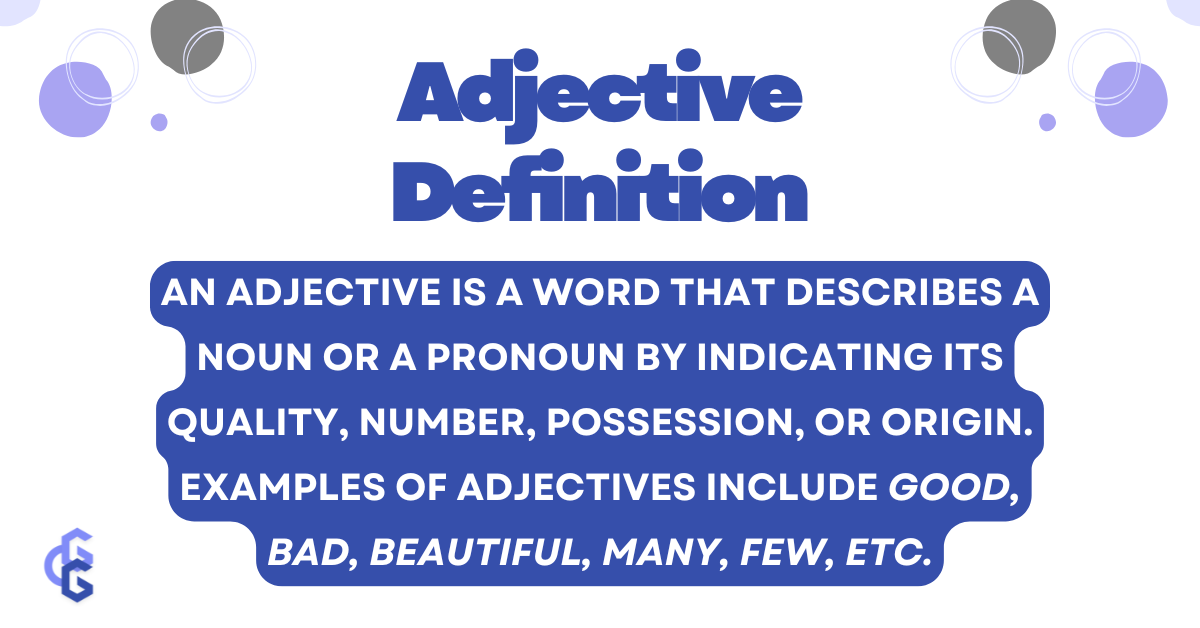
You can print and download this image if you want to use it later. Don’t worry! The image is free to use and share.
Ten (10) Examples of Adjectives Used in Sentences
Here are ten (10) example sentences that show the use of adjectives.
- Jack proudly carried a basket of fresh sweet potatoes into the farmhouse kitchen. [The adjective in this sentence is “fresh.”]
- He followed a complicated recipe he found scribbled on an old note. [The adjective in this sentence is “complicated.” “Old” is also an adjective.]
- Soon, a strange smell began drifting out of the oven. [The adjective in this sentence is “strange.”]
- The potatoes turned an unnatural shade of purple during baking. [The adjective in this sentence is “unnatural.”]
- Jack added a generous amount of sugar, hoping to fix the flavor. [The adjective in this sentence is “generous.”]
- Instead, the mixture became a sticky disaster that refused to leave the pan. [The adjective in this sentence is “sticky.”]
- A thick cloud of smoke filled the kitchen within minutes. [The adjective in this sentence is “thick.”]
- The farmer took one careful bite and immediately reached for water. [The adjective in this sentence is “careful.”]
- Everyone gave Jack a polite smile while secretly feeding the potatoes to the chickens. [The adjective in this sentence is “polite.”]
- By evening, Jack admitted it was his most disastrous cooking experiment yet. [The adjective in this sentence is “disastrous.”]
Types of Adjectives Explained with Examples
There are many different types of adjectives. Some sources on the internet may say there are six or seven, some may say there are a bit more.
According to GrammarGramps, there are seventeen (17) different types of adjectives. These include seven (7) common types of adjectives, and then an additional ten (10) that aregrouped by form (how they are built), position (where they appear), and special grammatical function.
Here is a detailed and organized breakdown.
1. Descriptive Adjectives
Purpose/Role: Describe qualities or characteristics.
Example Words: dusty, stubborn, noisy
Example Sentences:
- Jack chased a stubborn mule across the field.
- The dusty barn made him sneeze.
2. Quantitative Adjectives
Purpose/Role: Indicate amount (not exact number).
Example Words: some, much, little
Example Sentences:
- Jack had little patience left.
- He showed much determination.
3. Numerical Adjectives
Purpose/Role: Specify number or order.
Example Words: one, three, first
Example Sentences:
- He fed three mules before breakfast.
- It was his first week on the farm.
4. Demonstrative Adjectives
Purpose/Role: Point to specific nouns.
Example Words: this, that, these, those
Example Sentences:
- Those mules always escape.
- This fence needs repair.
5. Possessive Adjectives
Purpose/Role: Show ownership.
Example Words: my, your, his, her, their
Example Sentences:
- Jack forgot his hat.
- The mules kicked over their bucket.
6. Interrogative Adjectives
Purpose/Role: Introduce questions and modify nouns.
Example Words: which, what, whose
Example Sentences:
- Which mule broke the gate?
- Whose boots are in the mud?
7. Proper Adjectives
Purpose/Role: Derived from proper nouns and capitalized and used to indicate possession of said proper noun.
Example Words: Nepalese, Himalayan
Example Sentences:
- The Himalayan wind was freezing.
- Jack admired the Nepalese mountains.
Adjectives can also be grouped by form (how they are built), position (where they appear), and special grammatical function.
Below are the additional types of adjectives, beyond the basic ones.
Adjective Types by Form
8. Comparative Adjectives
Purpose/Role: Compare two nouns.
Example Words: stronger, louder, more stubborn
Example Sentences:
- This mule is more stubborn than that one.
- Jack is more tired today.
9. Superlative Adjectives
Purpose/Role: Show the highest or lowest degree within a group.
Example Words: strongest, loudest, most stubborn
Example Sentences:
- That is the most stubborn mule on the farm.
- It was the loudest bray Jack had ever heard.
10. Compound Adjectives
Description: Made of two or more words, often hyphenated before a noun.
Example Words: mud-covered, hard-working
Example Sentences:
- Jack wore a mud-covered jacket.
- His uncle owned a hard-working mule.
Read the full guide on compound adjectives by GrammarGramps.
11. Participial Adjectives
Description: Formed from verbs, usually ending in -ing or -ed.
Example Words: braying, exhausted, amused
Example Sentences:
- The braying mule woke the village.
- Jack felt exhausted after the chase.
Adjective Types by Position
12. Attributive Adjectives
Purpose/Role: Appear directly before the noun they modify. As the name shows, they indicate an attribute of the noun they precede.
Example Words: broken, heavy
Example Sentences:
- Jack repaired the broken fence.
- He carried a heavy bucket.
13. Predicate Adjectives
Purpose/Role: Follow a linking verb and describe the subject.
Example Words: angry, confused
Example Sentences:
- The mule was angry.
- Jack looked confused.
14. Appositive Adjectives
Purpose/Role: Placed after a noun for emphasis, often set off by commas.
Example Words: tired and muddy, wild and impatient
Example Sentences:
- Jack, tired and muddy, leaned against the barn.
- The mule, wild and impatient, refused to move.
Adjectives Types by Special Function
15. Distributive Adjectives
Description: Refer to members of a group individually.
Example Words: each, every, either, neither
Example Sentences:
- Each mule needed water.
- Every fence required repair.
16. Limiting Adjectives
Description: Restrict or narrow the noun rather than describe it.
Example Words: only, mere, certain
Example Sentences:
- Jack had only one clean shirt.
- A mere mistake upset his uncle.
17. Nominal Adjectives
Description: Function as nouns while retaining descriptive meaning.
Example Words: the injured, the elderly, the brave
Example Sentences:
- Jack helped the injured after a cart tipped over.
- The farm rewarded the brave.
What Are Comparative and Superlative Adjectives?
Let’s understand the concept of comparative and superlative adjectives.
- Comparative adjectives are used to compare two nouns. They indicate that one noun has more of a quality than another. For example, “The blue car is faster than the red car.”
- Superlative adjectives are used to show the highest or lowest degree of a quality within a group. They indicate that one noun has the most or least of a quality compared to all others. For example, “The blue car is the fastest car in the race.”
Here is an example of a word shown in its base, comparative, and superlative forms:
| Base | Comparative | Superlative |
|---|---|---|
| Fast | Faster | Fastest |
What Are Gradable and Non-Gradable Adjectives?
Comparative and superlative forms only exist for gradable adjectives. So what does that mean exactly?
A gradable adjective is one that can exist in varying degrees. You can be a little cold, quite cold, or extremely cold. The quality sits on a scale. A non-gradable adjective, on the other hand, describes a quality that either exists or does not. You cannot be a little dead or very dead. You are either dead or you are not.
There are two types of non-gradable adjectives: absolute adjectives and extreme adjectives.
What is an Absolute Adjective?
An absolute adjective is a non-gradable adjective that describes a binary quality. Words like “dead,” “full,” “complete,” and “impossible” are absolute adjectives. Something is either complete or it is not. There is no comparative or superlative form for these words. You would not say “more impossible” or “the most dead.”
You can read the full guide on absolute adjectives by GrammarGramps to learn more.
What is an Extreme Adjective?
An extreme adjective is also non-gradable, but for a different reason. Extreme adjectives are simply the most intense version of a gradable adjective. “Freezing” is the extreme version of “cold.” “Enormous” is the extreme version of “big.”
These adjectives already have “very” baked into their meaning, so you do not need to add it. You would not say “very freezing” or “very exhausted.”
There is a complete guide on extreme adjectives on GrammarGramps that you can check out to learn them in detail.
Order of Adjectives
When more than one adjectives appear in a sentence to modify the same noun or pronoun, they have to be mentioned in a specific order.
Here is the order:
Opinion → Size → Age → Shape → Color → Origin → Material → Purpose → Noun
Here are some examples:
- A small old wooden cabin
- That long icy Russian night
For native English speakers, following this order is instinctive. It comes naturally to them. If they don’t follow the order, it automatically feels weird.
For ESL students and non-native speakers, an effort may have to be made to learn the order.
Why Do We Need to Follow the Order of Adjectives?
English follows the order of adjectives to maintain clarity and to help the reader/listener properly understand the meaning of the sentence.
There is a reason behind the particular order of adjectives. When something is described using adjectives in the right order, it’s very easy to imagine it.
For example, if someone says, “A small, old, rusty axe,” the listener/speaker is able to instantly first imagine the smallness and oldness of the item before the item itself is introduced.
If someone says “A rusty, small, old axe,” the person has already pictured something rusty and they have to do a mental backflip when the words “small, old axe” are mentioned. They might have thought of a rusty nail. A rusty faucet.
With the right order, however, this problem doesn’t arise.
How Can I Memorize the Order of Adjectives?
GrammarGramps has got you covered. I made a mnemonic device that you can use.
So, the order goes like this, right?
Opinion → Size → Age → Shape → Color → Origin → Material → Purpose → Noun
Just remember this sentence: Often several antelopes smash cudgels on mushy and pulpy napkins.
The first letter of each word makes up “O S A S C O M P N.” You can remember what each of them stands for (O for opinion, S for size, etc.) and then easily recall the order using the mnemonic. There are two O’s and two S’s in there but…that much I’m afraid you’ll have to memorize.
Of course, if you’re aiming to learn the order of adjectives in this manner, you might be an ESL student and hence, confused as to what words like “cudgel” mean. Cudgel means a short and thick stick that is used as a weapon. Mushy means soft.
The mnemonic is easy to remember because of how bizarre it is. Just picture a forest clearing. A bunch of antelopes stand around, glancing at each other out of the corners of their eyes. Suddenly one of them produces a bunch of old checkered napkins. The others draw big sticks from behind them and then follows a sequence where they just beat everything out of those napkins. It’s a strange ritual.
There is actually a lot more to the order of adjectives, including the inclusion of “Quantity” adjectives at the start, as well as guidelines for predicate-only adjectives, and so on. We’ve covered all of that in detailed in our dedicated guide on Order of Adjectives in English.
Understanding Participles as Adjectives
Sometimes, verb forms can also serve as adjectives. For instance, a word might technically qualify as a verb, like “boiling,” but it can modify a noun and hence function as an adjective in a specific instance.
For instance, in phrase like “the boiling heat,”or “the boiling concrete floor,” the word boiling serves as an adjective as it modifies nouns.
But in other instances, someone might say “I am boiling some water”. Here, it’s a clean verb and not an adjective as it indicates an activity.
It’s important to remember that it’s fine for a word to be a verb form but also qualify as an adjective at the same time. If you ever run into an exercise where this distinction appears to be blurred, just know that it’s nothing to worry about.
If you say that such words are verbs but they serve the function of adjectives, it’s perfectly fine.
How to Identify Adjectives: Easy Method by GrammarGramps
Here is an easy method to identify adjectives in a sentence.
When you read a sentence, ask yourself: is there a person, place, thing, or idea being mentioned in this sentence? In almost every sentence that you read, there will be something that fits that description.
Then ask yourself these questions: What kind is it? How big is it? How many are there?
There will often be a word nearby that answers one of these questions. That word is usually the adjective. It describes or limits the noun in some way.
For instance,
Jack tried to repair the broken fence in the frozen field.
In this sentence, we know that Jack attempted to repair a fence. But when I begin asking the questions mentioned above, I notice that the word “broken” tells me what kind of fence it was, and the word “frozen” tells me what kind of field Jack is standing in.
Those are the adjectives.
It is important to know that adjectives aren’t like nouns and verbs. A sentence can easily exist without them. If you ask yourself the questions “what kind?” or “which one?” and no word answers those questions, then the sentence simply does not contain an adjective.
Jack, for instance, could just stand in a field and do nothing. The sentence Jack stood in a field still works perfectly fine. It just gives us fewer details about the unfortunate conditions of his life on that Siberian farm.
How to Learn Adjectives: Advice by GrammarGramps
The more adjectives you know, the more accurate and descriptive your sentences become. That’s why learning new adjectives is a useful and worthwhile exercise.
There are two methods that are suggested by GrammarGramps for learning adjectives.
- The first thing that you can do is check out the list of 100+ adjectives that I’ve published here on the website. The list contains a sizeable amount of adjectives along with their meanings. The list also mentions which type each adjective belongs to and what it defines. This is an excellent, focused method that you can use to learn new adjectives.
- The second thing that you can do is more passive. It’s what GrammarGramps advises you to do for learning a lot of grammar-related stuff, i.e., read a lot. And not just read, but read with an eye out for adjectives. For example, if you’re reading a news article, you should keep an eye out for any adjectives that might appear. That way, you’ll grow better and better at identifying adjectives while building your vocabulary at the same time.
Common Grammatical Errors with Adjectives and their Fixes
There are different types of mistakes and errors that people can make when using adjectives. In the table below, I’ve mentioned some of the common errors along with examples to illustrate them. I’ve also mentioned how each of those errors can be fixed with the help of examples.
| Error | Example (Incorrect) | Fix (Correct) |
| Confusing adjectives with adverbs | She sings beautiful. | She sings beautifully. |
| Incorrect comparative form | This solution is more better than the last one. | This solution is better than the last one. |
| Incorrect superlative form | He is the most smartest student in the class. | He is the smartest student in the class. |
| Incorrect adjective order | She bought a leather small black bag. | She bought a small black leather bag. |
| Using adjectives instead of noun forms | She has strong. | She has strength. |
| Misplaced adjective causing ambiguity | She served sandwiches to the children on paper plates. | She served sandwiches on paper plates to the children. |
| Missing hyphen in compound adjectives | They built a high speed train network. | They built a high-speed train network. |
| Using adjective where determiner is required | Much people attended the event. | Many people attended the event. |
I mentioned the confusion between adverbs and adjectives in the guide on “What is an Adverb?” Be sure to check it out so that you can learn more about how to avoid this mistake.
Common Questions About Everyday Words Being Adjectives
GrammarGramps has published different short guides exploring the nature of everyday words, i.e., whether they are adjectives or some other parts of speech. You should check these out and improve your understanding of the general concept. The links to those guides have been provided below:
- Is the Word “Afraid” an Adjective?
- Is the Word “Aware” an Adjective?
- What Part of Speech is “Beautiful”?
- What Part of Speech is “Alive?”
- Is the Word “Good” an Adjective?
Short Quiz on Adjectives by GrammarGramps
Here is a short quiz that I have made so that you can quickly test your understanding of the concepts that I explained in the guide above. If you can nail all of these questions, you’ll officially be able to expertly answer should anyone ask you “What is an adjective?” when you’re walking down the street.
Oh, and yes. The answer key is provided below the quiz. Take the quiz first and then check your answers.
Once you’re done with this quiz, I recommend that you check out the glossary of English grammar by GrammarGramps. There’s a lot that you can learn there, and it’s also a great way to find and jump to the next guide that you want to tackle.
- What is the adjective in this sentence:Jack crossed the frozen river.
A. crossed
B. frozen
C. river - In the order of adjectives, size comes after material. Is this statement correct?
A. Yes
B. No - What is the adjective in this sentence: He carried three blankets.
A. carried
B. three
C. blankets - What type of adjective is this: seventy.
A. Numerical
B. Superlative
C. Demonstrative - How many types of adjectives are there, according to GrammarGramps?
A. 20
B. 17
C. 7
Answer Key
- B
- B
- B
- A
- B
FAQs About Adjectives in Grammar
Here are some questions that you may have in mind after reading this guide. We’ll answer them so that there is no confusion left.
Here is an easy definition of adjectives that you can memorize: Adjectives are quality words. They describe the qualities and properties of people, places, and things.
GrammarGramps has mentioned 17 types of adjectives in this guide. Seven of those types are the recognized and “standard” types while the remaining ones are those formed on the basis of structure, placement, and so forth. The seven traditional types include descriptive adjectives, quantitative adjectives, numerical adjectives, demonstrative adjectives, possessive adjectives, interrogative adjectives, and proper adjectives.
Yes, by a significant margin. Adjectives appear in almost every sentence that contains a noun, since describing people, places, and things is a natural part of how we communicate. Adverbs, while common, are used more selectively and are easier to leave out without a sentence losing its basic meaning.
An adjective describes a noun or pronoun. An adverb describes a verb, an adjective, or another adverb. The simplest way to tell them apart is to ask what the word is modifying. In “the cold wind,” cold is an adjective because it describes the noun “wind.” In “it blew fiercely,” fiercely is an adverb because it describes the verb “blew.”
Postpositive adjectives are the adjectives that come immediately after a noun rather than before it. They are not the same thing as predicate adjectives. Predicate adjectives come after a linking verb. Postpositive adjectives come right after the noun without any linking verb in between. For instance, in a sentence like, “He is the person guilty of the crime,“ the adjective “guilty” comes after the noun “person” without any linking verb.
Resources Used for This Guide
Among others, here are the resources that I used for this guide:
